 Add to Chrome
 Add to Firefox
 Add to Edge
Automated Random Embedding for Practical Bayesian Optimization with Unknown Effective Dimension
May 25, 2026
Bayesian optimization is widely employed for optimizing complex black-box functions but struggles with the curse of dimensionality. Random embedding, as a dimension reduction strategy, simplifies tasks that possess the effective dimension by optimizing within a low-dimensional subspace. However, determining the effective dimension of a task in advance remains a significant challenge, which influences the selection of the subspace dimensionality and the optimization performance. Traditional methods use fixed subspace dimensions provided by experts or rely on trial and error to estimate subspace dimensions with resources consumed. To this end, this paper proposes an automated random embedding for high-dimensional Bayesian optimization with unknown effective dimension, called Dynamic Shared Embedding Bayesian Optimization (DSEBO). DSEBO starts with a low dimension and switches to a higher subspace if the solutions in the current subspace show preliminary convergence. DSEBO dynamically determines the dimension of the next subspace based on the quality of the solutions in different subspaces and shares the queried solutions with the new subspace for a better initialization. Theoretically, we derive a regret bound for DSEBO and demonstrate that DSEBO can better balance approximation and optimization errors. Extensive experiments on functions with dimensionality of varying magnitudes and real-world tasks with unknown effective dimensions reveal that, compared with state-of-the-art methods, alternating optimization across different subspaces results in significant improvements in high-dimensional optimization, both in terms of optimization regret and time.

SepSeq: A Training-Free Framework for Long Numerical Sequence Processing in LLMs
Apr 09, 2026While transformer-based Large Language Models (LLMs) theoretically support massive context windows, they suffer from severe performance degradation when processing long numerical sequences. We attribute this failure to the attention dispersion in the Softmax mechanism, which prevents the model from concentrating attention. To overcome this, we propose Separate Sequence (SepSeq), a training-free, plug-and-play framework to mitigate dispersion by strategically inserting separator tokens. Mechanistically, we demonstrate that separator tokens act as an attention sink, recalibrating attention to focus on local segments while preserving global context. Extensive evaluations on 9 widely-adopted LLMs confirm the effectiveness of our approach: SepSeq yields an average relative accuracy improvement of 35.6% across diverse domains while reducing total inference token consumption by 16.4% on average.
LLMOPT: Learning to Define and Solve General Optimization Problems from Scratch
Oct 17, 2024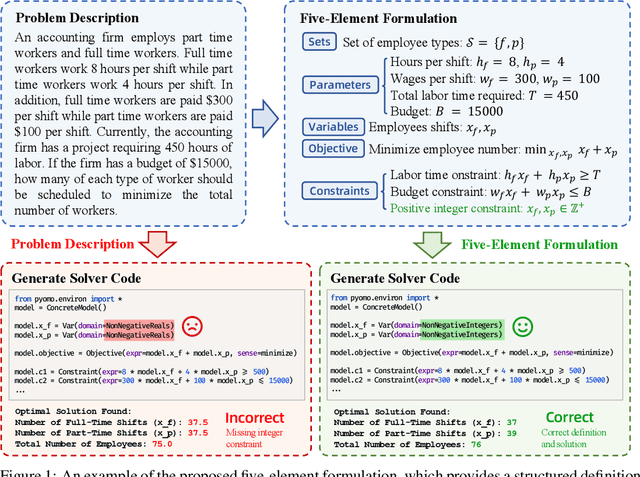
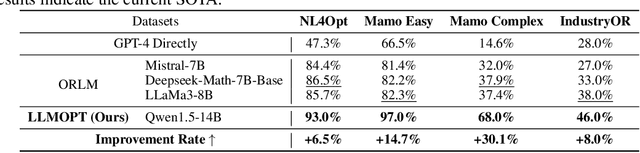
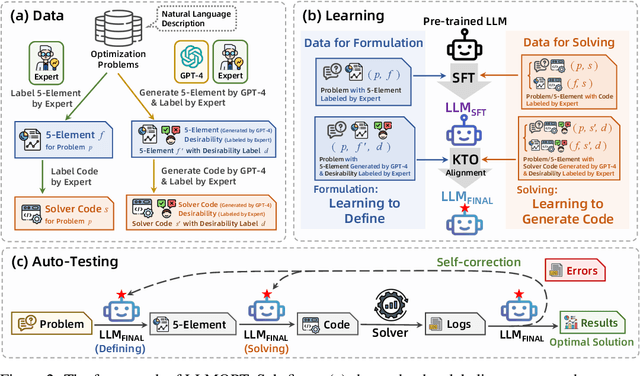
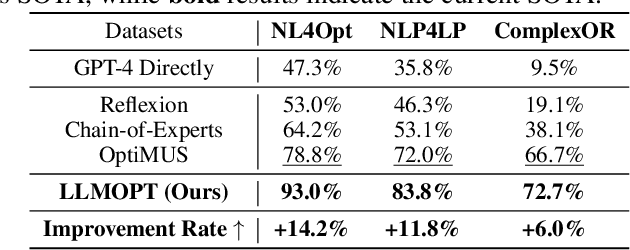
Optimization problems are prevalent across various scenarios. Formulating and then solving optimization problems described by natural language often requires highly specialized human expertise, which could block the widespread application of optimization-based decision making. To make problem formulating and solving automated, leveraging large language models (LLMs) has emerged as a potential way. However, this kind of way suffers from the issue of optimization generalization. Namely, the accuracy of most current LLM-based methods and the generality of optimization problem types that they can model are still limited. In this paper, we propose a unified learning-based framework called LLMOPT to boost optimization generalization. Starting from the natural language descriptions of optimization problems and a pre-trained LLM, LLMOPT constructs the introduced five-element formulation as a universal model for learning to define diverse optimization problem types. Then, LLMOPT employs the multi-instruction tuning to enhance both problem formalization and solver code generation accuracy and generality. After that, to prevent hallucinations in LLMs, such as sacrificing solving accuracy to avoid execution errors, model alignment and self-correction mechanism are adopted in LLMOPT. We evaluate the optimization generalization ability of LLMOPT and compared methods across six real-world datasets covering roughly 20 fields such as health, environment, energy and manufacturing, etc. Extensive experiment results show that LLMOPT is able to model various optimization problem types such as linear/nonlinear programming, mixed integer programming and combinatorial optimization, and achieves a notable 11.08% average solving accuracy improvement compared with the state-of-the-art methods. The code is available at https://github.com/caigaojiang/LLMOPT.